
Slow Cooker Amish Rice Pudding: The Creamiest Old-Fashioned Dessert You’ll Ever Make
There are desserts you make to impress, and then there are desserts you make to comfort. This Slow Cooker Amish Rice Pudding belongs firmly in the second camp — and it just so happens to be one of the most satisfying, soul-warming things you can pull out of your kitchen with almost zero effort. Rooted in the wholesome, thrifty cooking traditions of Amish communities across the Midwest, this pudding asks nothing more of you than a handful of pantry staples, a slow cooker, and a little patience. In return, it fills your home with the heady scent of warm cinnamon and vanilla, and delivers a dessert so creamy, so deeply comforting, it tastes like something your grandmother would have made on a cold Sunday evening. No fancy technique. No obscure ingredients. Just humble, honest cooking doing exactly what it has always done best.
The Story Behind Amish Rice Pudding
Amish cooking has always been defined by its philosophy of simplicity and resourcefulness. Families in the Midwest Amish tradition have long known that the finest desserts don’t require elaborate steps or expensive components — they require time, care, and quality everyday ingredients. Rice pudding fits that tradition perfectly. A cup of raw rice, a generous pour of whole milk, a few eggs and pantry spices — that’s all it takes to produce something that feels genuinely luxurious. Slow cooking is the key. The long, gentle heat coaxes the starch out of the rice and into the milk, creating a naturally thick, silky custard without any added thickeners or complicated processes. This is food that respects your time and your budget while delivering results that feel anything but ordinary.
Ingredients
This recipe serves 6. Every ingredient earns its place — nothing is here by accident.
- 1 cup raw white rice (short or medium grain strongly preferred — they release more starch and give a creamier result than long grain)
- 4 cups whole milk (do not substitute reduced-fat milk — the fat is essential for richness and texture)
- ½ cup granulated sugar
- 2 large eggs, lightly beaten
- 1 teaspoon pure vanilla extract
- 1 teaspoon ground cinnamon, plus extra for serving
- Butter or non-stick cooking spray, for the slow cooker insert
Optional add-ins: ½ to ¾ cup raisins or chopped dried fruit, a pinch of ground nutmeg, one whole cinnamon stick, or a swap of brown sugar for white.
Step-by-Step Instructions
Step 1: Prepare the Slow Cooker
Lightly butter or spray the inside of a 4- to 6-quart slow cooker. This small but important step prevents the pudding from sticking to the edges as it cooks and makes cleanup considerably easier. Don’t skip it.
Step 2: Add the Rice
Pour the raw white rice directly into the bottom of the prepared slow cooker and spread it into an even layer. There is no need to rinse or pre-cook the rice — it goes in completely raw, and the slow, gentle heat will cook it perfectly from start to finish.
Step 3: Make the Custard Mixture
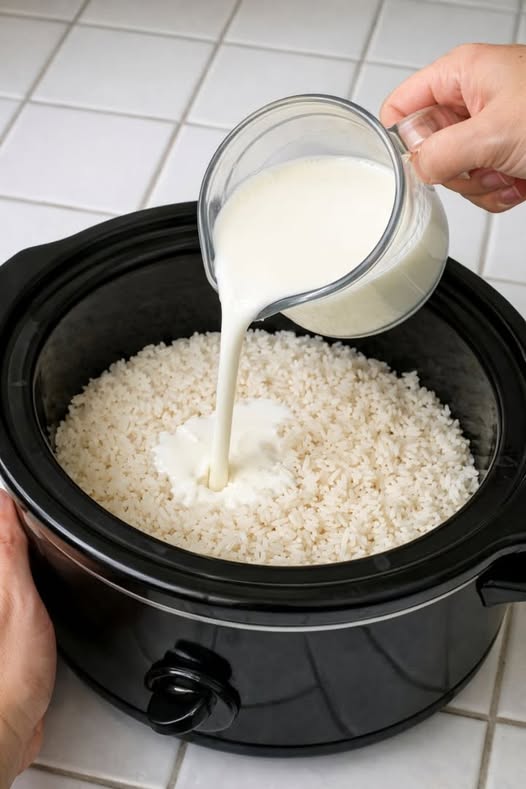
In a medium mixing bowl or a large measuring cup with a spout, whisk together the whole milk, granulated sugar, lightly beaten eggs, vanilla extract, and ground cinnamon. Whisk until the sugar is mostly dissolved and the eggs are completely incorporated with no visible streaks. A measuring cup with a spout makes pouring cleaner and more controlled.
Step 4: Combine in the Slow Cooker
Slowly pour the milk and egg mixture over the rice in the slow cooker, making sure all the grains are moistened and submerged. The rice will float and shift — that’s perfectly normal. Give it a gentle stir to ensure even distribution, then leave it alone.
Step 5: Cook on Low
Place the lid on the slow cooker and set it to LOW. Cook for 3 to 4 hours. Resist the urge to lift the lid during the first couple of hours — every time you do, you release heat and add time. The pudding is ready when the rice is completely tender, the edges have set, and the center is thick and wobbly but no longer soupy. Slow cookers vary in temperature, so start checking at the 3-hour mark.
Step 6: Stir During the Final Hour
During the last hour of cooking, open the lid and give the pudding one or two gentle stirs. This prevents the rice from settling to the bottom and stops the edges from scorching. Replace the lid promptly each time to retain heat. These brief stirs also help create a more uniform, creamy texture throughout.
Step 7: Rest Before Serving
Once the pudding is thick and creamy and the rice is fully cooked, switch off the slow cooker. Leave the pudding covered and undisturbed for 15 to 20 minutes. During this resting time, the pudding will thicken further and the residual heat will finish the cooking process gently. This step is what separates a great rice pudding from a truly exceptional one.
Step 8: Serve and Enjoy
Spoon the warm pudding into small bowls and dust the top with an extra sprinkle of ground cinnamon. If the pudding has thickened more than you’d like, simply stir in a splash of warm whole milk until it reaches your desired consistency. Serve immediately while warm.
Why This Recipe Is So Universally Loved
Ask anyone who has made this recipe why they keep coming back to it, and the answers are surprisingly consistent. First, it is the easiest dessert imaginable — you combine six ingredients, press a button, and walk away. There is no stirring over a hot stove, no babysitting a bain-marie, no risk of scorching on direct heat. Second, the slow cooker produces a depth of creaminess that stovetop methods genuinely struggle to match. The long, low heat allows the starch from the rice to release slowly and naturally into the milk, building a thick, silky custard from the inside out. Third, this recipe is endlessly forgiving and infinitely adaptable. It welcomes raisins, warming spices, different sugars, and richer dairy with equal ease. And finally, it simply tastes like home — like the kind of dessert that has no agenda other than to make you feel warm and taken care of.
Pro Tips for Perfect Amish Rice Pudding
- Choose the right rice. Short or medium grain white rice is the best choice for this recipe. Varieties like Arborio, sushi rice, or standard short grain white rice release significantly more starch than long grain varieties, which translates directly into a creamier, thicker pudding. Long grain rice will still work, but the result will be noticeably less rich.
- Use full-fat whole milk. This is not the place for 2% or skim milk. The fat content in whole milk is what gives the pudding its body and velvety mouthfeel. If you want to go even further, replace one of the four cups of whole milk with half-and-half or heavy cream for an extraordinarily rich result.
- Temper your eggs. For an ultra-smooth custard, whisk a few tablespoons of the warm milk mixture into your beaten eggs before adding them to the rest of the liquid. This brings the eggs up to temperature gradually and reduces any risk of curdling.
- Don’t lift the lid too early. Every minute the lid is off, you lose heat and steam. Stick to the recipe’s instruction to stir only during the final hour.
- Your slow cooker’s personality matters. All slow cookers run slightly differently. If yours tends to run hot, start checking for doneness at 2 hours and 45 minutes. If it runs cool, it may need the full 4 hours or even a few minutes beyond.
- Add dried fruit at the right time. If you’re adding raisins or dried fruit, stir them in during the last 30 minutes of cooking. Added too early, they will absorb too much liquid and become mushy. Added at the end, they plump up beautifully and retain their texture.
- Embrace the resting period. The 15 to 20 minutes of covered resting time after cooking is not optional — it is part of the process. The pudding will thicken noticeably during this window, and the flavours will deepen and meld. Be patient; it’s worth every minute.
Serving Suggestions
This rice pudding is deeply satisfying on its own, but the right accompaniments can make it feel like a truly special occasion dessert.
- The classic finish: A generous dusting of ground cinnamon or freshly grated nutmeg over each bowl is the simplest and most traditional way to serve this pudding. It costs nothing and adds everything.
- Warm with jam: A spoonful of homemade strawberry jam, sour cherry preserves, or apricot conserve spooned alongside adds a bright, fruity acidity that cuts through the richness of the pudding beautifully.
- Chilled with fresh berries: Leftover pudding that has been refrigerated overnight becomes thicker and denser — almost like a set custard. Serve it cold the next morning topped with fresh strawberries, blueberries, or raspberries for a breakfast that feels like a treat.
- With a drizzle of maple syrup: A thin drizzle of pure maple syrup adds a warm, earthy sweetness that pairs wonderfully with the cinnamon notes in the pudding.
- The drink pairing: A cup of strong black coffee or a pot of properly brewed tea makes this feel like a considered, sit-down dessert moment. For a more casual evening snack, a tall glass of cold whole milk is the quintessential Amish accompaniment — simple, wholesome, and perfect.
- For a celebratory twist: Serve in small glass jars or ramekins, top with a spoonful of whipped cream, and finish with a dusting of cinnamon and a few toasted pecans for a dessert that looks as good as it tastes.
The Final Word: The Simplest Dessert You’ll Make All Year
In a world full of complicated recipes that demand specialist equipment, imported ingredients, and hours of active cooking time, this Slow Cooker Amish Rice Pudding stands as a quiet, confident rebuke to all of that noise. It is proof — if proof were ever needed — that the most memorable food is often the most straightforward. Six everyday ingredients. One slow cooker. Three to four hours of patient, hands-off cooking. The result is a dessert of extraordinary creaminess, gentle warmth, and deep, old-fashioned comfort that no amount of culinary complexity could improve upon. It is the kind of recipe that gets written on index cards and passed between neighbours, that gets requested at every family gathering, and that becomes a quiet household institution within weeks of first being made. Make it tonight. Serve it warm. Watch it disappear — and then make it again.